|
By C.J. Cintas, Cattails teacher
“Sneak a peek” is a game that can be played inside or out. It involves 4-5 items that are small enough to fit under a handkerchief. It is a useful way to extend your child’s pattern recognition, imagination, and to introduce them to just about anything. 1. First, decide what you want to hide. I like to use this game to introduce children to plants. In particular, useful plants that begin to show up in the Spring. So, I might pick 4 or 5 plant leaves or flowers that I want to hide but it could be done with anything. 2. Hide your items underneath the handkerchief or cloth and tell your child you have something to show them. Make sure you are enticing. It’s exciting to have a surprise hiding under something. I often tell them they will need to find a matching leaf to find out what it is. 3. Show your child the item and set them on their finding adventure. I like to point out details such as shape, size, and color as the child looks at the items. How many items are there? 4. Allow your child time to find the items on their own and bring them back to match with yours. It’s important to let your child find the items on their own to strengthen their will and build their self confidence. 5. Continue the game as many times as you’d like. You can increase the number of items or arrange them in a specific pattern under the handkerchief. You can limit the amount of time your child has to peek and so on. Most importantly, have fun! Posted by Heather Young, Water Striders teacher
Sing of the earth and sky, sing of our lovely planet, sing of the low and high, of fossils locked in granite. Sing of the strange, the known, the secrets that surround us, sing of the wonders shown, and wonders still around us. --Aileen Fisher Take a walk either alone or with your child. As you walk slowly along try singing or humming in response to what you are noticing around you. Your song can be a tune with or without words. Open up all of your senses and notice what you feel inside of your own body as you perceive the shapes, textures, colors, smells, sounds and sensations of your surroundings. Aboriginal creation myths tell of creator-beings who wandered over the continent in the Dreamtime, singing out the names of everything that crossed their path - birds, animals, plants, rocks, waterholes; singing the world into existence. As simple as it is, when we sing or hum a known or improvised tune, we participate in ancient medicine. Modern science now confirms what humans have intuited all along, that no matter our age or culture, singing is one of the best ways to help ourselves feel better.  Posted by Lia Grippo
Creating a nature table in your home can become a source of beauty, reverence, awe for the whole family. A nature table helps us to maintain connections with the greater natural world within our homes. Items gathered while wandering and exploring become touchstones for memories of our adventures, they deepen our awareness of the rhythms of life in the natural world, and offer enrichment for our children’s play and sensory experiences within the home. Setting the Table Find a small table, shelf, or other space at child’s eye level This can even be a box turned upside down and covered with cloth A large space isn’t necessary (less is more). In fact a smaller space will be easier to tend. Choose a spot where the family can see it, where it can become a source of rest for the eyes and the heart. Simplicity is Key Cover the nature table with a beautiful cloth A scarf, table cloth, piece of clothing, pillow case or sheet, etc. Feel free to use more than one cloth to add richness. Make it Beautiful Your loving tending will signal to your children that this is a special place. Place found “treasures” from walks in nature, in the neighborhood, or around the home on your nature table. Keep it Fresh Add cut flowers, branches of blooming trees, etc. to the table. (items that will require intermittent tending keep the space fresh and engaging) You and/or your children can make small items to add to it For example, your child might make a grass nest and fill it with items that remind them of eggs Your child might want to add a drawing of a beloved, bird, animal, or plant. Feel free to add a small animal toy or two if you wish Let the Imagination be the Guide 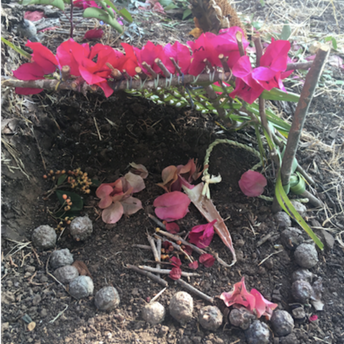 Posted by Anne McCarthy, Cattails teacher
Where would a fairy like to live? What does a gnome need to feel at home? Dedicating a spot in your yard (or in a natural area you visit frequently, if a yard is not available) as a place where your child can construct a fairy or gnome home, has many benefits:
There are no rules to building fairy houses, no right or wrong way. They’re all different, and interesting in their own way. Some might be tall, others underground… You might be surprised what your child will come up with. So get out there and start building (you might even want to make one yourself, who knows?)  Posted by C.J. Cintas, Cattail teacher
Feeding the birds and tending a space is one of the best ways to create ritual at home. Ritual goes hand in hand with Rhythm. The birds will teach us how to get in a daily rhythm if we watch closely. Every morning the House finches fly down from the Elm tree and begin to pick the fresh buds off the Wysteria for their breakfast. Soon after that, the Ravens know it’s safe to leave their nest in the Pine tree and begin their search for food. It’s their daily ritual. Young children are learning and deciding what is important in their lives based on the day to day rituals they experience. They see adults tending to and caring for their home and family and want to practice it too. Bird feeders are an offering for children to tend their world in a meaningful and magical way.
Is there still food? Has the nest been scratched through? Are there any feathers left behind? Can you see who has been eating from inside the house or from across the yard? There are many curiosities one can follow as soon as you begin to tend the birds. The best part, the birds will only come if you are still, quiet and calm. If you tend your nest each day, soon you'll be in rhythm with the birds. |
AuthorWild Roots staff authors include Erin Boehme, Lia Grippo, CJ Cintas, Anne McCarthy, Tyler Starbard, Jenn Sepulveda, Heather Young, Amalia Smith Hale, Natalia Pareja... Archives
May 2020
Categories
All
|
 RSS Feed

COPYRIGHT © WILD ROOTS 2016-2022. ALL RIGHTS RESERVED.